
🚚 FREE DELIVERY IN UKRAINE • 📞 QUICK ORDER: +380 63 571 3650 • 📚 STEM KITS FOR HOME, SCHOOL AND CLUBS
🚚 FREE DELIVERY IN UKRAINE • 📞 QUICK ORDER: +380 63 571 3650 • 📚 STEM KITS FOR HOME, SCHOOL AND CLUBS
🚚 FREE DELIVERY IN UKRAINE • 📞 QUICK ORDER: +380 63 571 3650 • 📚 STEM KITS FOR HOME, SCHOOL AND CLUBS

Surface Tension Science Experiments for Kids
Surface tension is an amazing phenomenon that is often forgotten. It is the force that allows insects to walk on water, and it
Surface tension is an amazing phenomenon that is often overlooked. It is the force that allows insects to walk on water, and it is also responsible for the formation of bubbles.
In this article, you’ll learn about the science behind the interesting force and how to perform simple surface tension experiments to demonstrate its effects.
Surface tension is a powerful force that can have both practical and scientific applications. By understanding the science behind this phenomenon, you can learn to harness its power.
What is surface tension?
Surface tension is a unique phenomenon due to which the surface of a liquid behaves like a thin elastic elastic membrane during contact with air.
This is the force that allows water to form drops and bubbles. It is also responsible for the stability of these forms.
Related: Learn how to make homemade bubbles with this easy recipe!
Remember the little trick you can use to make a paper clip float on water? This is nothing more than a water surface tension trick!
Surface tension is created by the intermolecular forces of a liquid that pull the molecules of the liquid together. These cohesive forces between molecules create tension on the surface of the liquid, which provides unique properties.
The reason why this force is only visible on the surface is quite simple. Inside the liquid, the gravitational forces acting on the molecule are equalized by equal forces in opposite directions from neighboring molecules.
However, on the surface, everything is different. There are no liquid molecules above the surface, so the liquid molecules are pulled inward, resulting in tension along the liquid surface.
Surface tension Fun fact: did you know that the Basilisk lizard can walk on water? Check out other interesting “Weird But True Fun Facts” and get ready to be amazed!
Experiment with surface tension
The best way to learn something is to learn by doing. These simple and easy science experiments for kids will help your little ones understand what it is and how it can be controlled.
Scientific experiment “Pepper and soap”
In the Pepper and Soap experiment, you will observe how the surface tension of water can be changed using a common household item such as dish soap.
For children, this is a great practical hygiene task that helps them understand how cute it is. helps clean our hands.
This simple experiment for kids helps them understand surface tension and how soap and detergents work.
You will need:
– a shallow bowl with water
– ground pepper/pepper flakes
– liquid dish soap
– a toothpick (you can also use a finger)
How to do it:
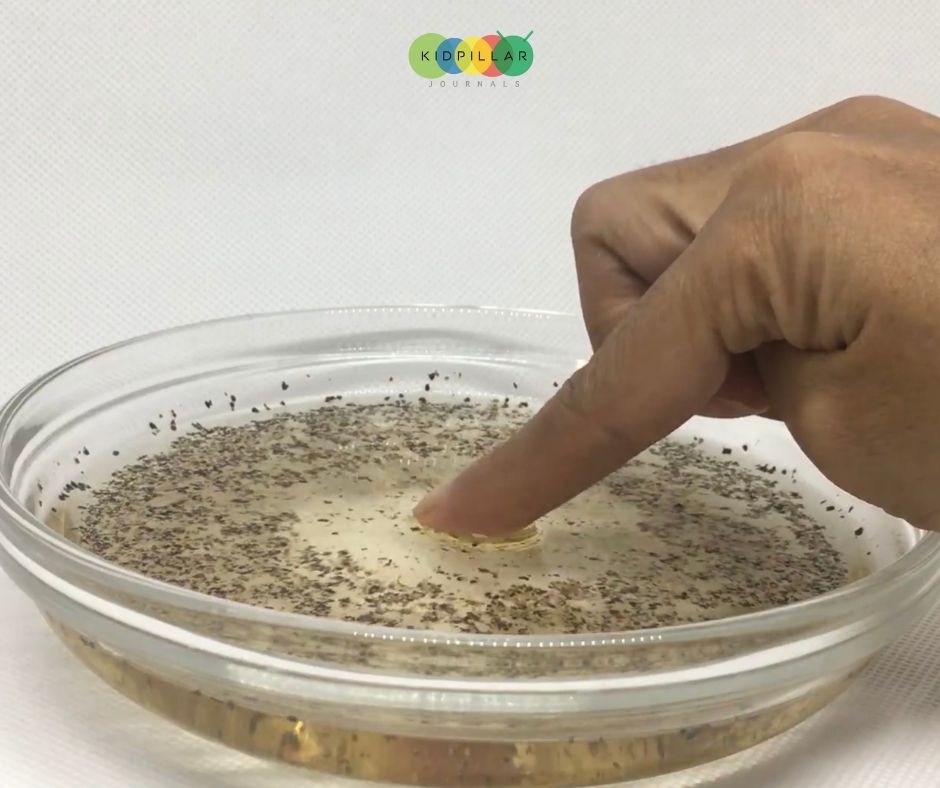
1. Pour pepper flakes into the water. Try to sprinkle pepper evenly. Pepper flakes will float on the surface of the water.
2. Dip a toothpick (or finger) in soap and gently touch the soapy toothpick to the surface of the water near the center of the bowl.
This will cause the pepper flakes to spread and float along the sides away from your finger, making a hole in the surface of the water.
It’s almost magical to see the pepper pop up with a touch of your soapy finger! While it may look like magic, there’s actually simple science at work in this soapy experiment.
The beauty of this experiment is how easy it is! This is an ideal science experiment for both preschoolers and older children.
Soap is one of the most common household items, but did you know that it can also be used to reduce the surface tension of water?
The high surface tension of water is created by the cohesive nature of water molecules. Water molecules are attracted to each other by so-called hydrogen bonds.
Hydrogen bonds are formed when the hydrogen atom of one water molecule is attracted to the oxygen atom of another water molecule.
When soap is added to water, it reduces the attraction between water molecules, resulting in a decrease in surface tension.
After contact with the surface of water, soap affects the surface tension of water, reducing the cohesive forces between water molecules. This causes them to spread, causing the pepper flakes to float with them.
Quick Tip: Be sure to include a science joke to speed up the learning process! They will not only make your children laugh, but also increase their interest.
Experiment with magic milk
In this cool science experiment, you’ll add dish soap to milk and see how it affects the surface tension of the milk.
Similar to the soap and pepper experiment, this is a simple science experiment for kids that allows them to understand this fascinating phenomenon and discover how soap and detergents work.
You will need:
– a small bowl of milk
– liquid soap
– food dyes
– earphone
How to do it:
1. Pour the milk into a small bowl.
2. Add a few drops of food coloring to the milk.
3. Dip the tip of the earpiece into dishwashing detergent and gently touch the food coloring floating on the surface of the milk.
When the soap molecules collide with the milk molecules, their surface tension changes, causing the colors to swirl and mix in an amazing way!.
The surface tension of milk is created by the forces of attraction between milk molecules.
When soap touches the surface of milk, it breaks its surface tension, reducing the cohesive forces between milk molecules. This causes the molecules to spread, taking the food coloring with them.
The magic milk experiment is a great way to learn about surface tension and how soap reduces it. It’s also a lot of fun to watch the colors spill out!
This exciting, colorful science experiment never ceases to amaze kids!
Similar: Also learn why the wind blows with this easy, kid-friendly guide.
Application of surface tension
Although surface tension is often discussed because of its effect on water, it also has a variety of applications in other areas. regions
One such application is medicine. Surface tension can be used to prevent the spread of bacteria and viruses.
For example, in hospitals, surgeons often use soap to reduce the surface tension of their hands before rubbing them. This helps remove any bacteria or viruses that may be on the skin.
Related: Teach your kids about hygiene by doing with Hygiene Experiments for Kids.
Similarly, detergents are used to lower the surface tension of water to increase its wettability. In this way, water is more easily absorbed into the soiled laundry.
Surface tension is also used in the production process. It is used to apply thin layers of material to objects using a process known as dip coating.
In this process, the object is immersed in a tank of liquid material. The surface tension of the liquid draws the material to the object, forming a thin, even coating.
As you can see, surface tension can have a variety of applications in different areas. In this article, you’ll learn about the science behind it and how to conduct simple experiments to demonstrate its effects.
We hope this article has sparked your child’s interest in STEM and that they will continue to explore the wonderful world of surface tension!