
🚚 FREE DELIVERY IN UKRAINE • 📞 QUICK ORDER: +380 63 571 3650 • 📚 STEM KITS FOR HOME, SCHOOL AND CLUBS
🚚 FREE DELIVERY IN UKRAINE • 📞 QUICK ORDER: +380 63 571 3650 • 📚 STEM KITS FOR HOME, SCHOOL AND CLUBS
🚚 FREE DELIVERY IN UKRAINE • 📞 QUICK ORDER: +380 63 571 3650 • 📚 STEM KITS FOR HOME, SCHOOL AND CLUBS

Popcorn Science Experiment For Kids – Why Does Corn Pop?
This fun Popcorn Science Experiment will get you into science and your kids will appreciate the mechanics of nature, not to mention
This fun Popcorn Science Experiment will immerse your kids in science and make them appreciate the mechanisms of nature, not to mention amaze them! But before starting the experiment with popcorn for children, ask the question – why does popcorn pop?
Why does popcorn pop?
Simply put, popcorn kernels contain a small amount of water. When this water is heated, it turns into steam. This steam creates pressure inside the core and must escape. And so it bursts outwards, causing the core to burst and spill its innards!
This is a simple explanation for why popcorn pops for children, especially younger ones. But for older kids — tweens and tweens — can you dig deeper with this step-by-step explanation of why popcorn pops?
1. Magic inside the core
To pop out, the kernels need the right amount of moisture inside and enough thickness. A moisture content of 13.5-14% is ideal for the grains to burst.
Not all corn kernels can burst due to differences in the thickness of the shell or outer shell, which is technically called the pericarp.
2. The heat turns the core into a steam chamber
When the core is heated, the water inside it evaporates and turns into steam. The steam expands inside the kernel, cooking the starch in the grain and putting pressure on the shell.
At a temperature of about 180 C, the pressure built up inside the core reaches about 135 psi. At this point, the hull can no longer withstand and is ready to burst.
3. Boom — popcorn served!
Finally, the case bursts open and steam comes out! At the same time, the soft inner part of the kernel, called the endosperm, expands and bursts. This puffed up soft starch is then cooled into the fluffy white popcorn you know!
4. What is that sound? That sound you hear is actually a mini explosion of steam bursting through the shell! So when you hear a pop, know that the popcorn is ready!
The next time your kids ask for popcorn, be sure to ask this question to get into some fun science! After all, nothing beats hands-on science activities accompanied by arguably the world’s most favorite snack – the humble popcorn!
Related: Explore the science behind why onions make you cry!
Science experiment with popcorn
This simple science experiment will help kids understand the science behind making popcorn. This is a practical way to understand the role of heat, pressure and water present in the kernel in popping popcorn.
Consumables:
- Popcorn grains
- 2 pans
- Plate
Instructions
1. Label the pots as pot A and pot B. Add the same amount of corn kernels to each.
2. Add 1 teaspoon of butter to each pot.
3. Place pot A on high heat and pot B on low heat for five minutes.
4. Turn off the stove after five minutes and see which pot has the most popcorn. Write down your observations.
Science experiment with popcorn
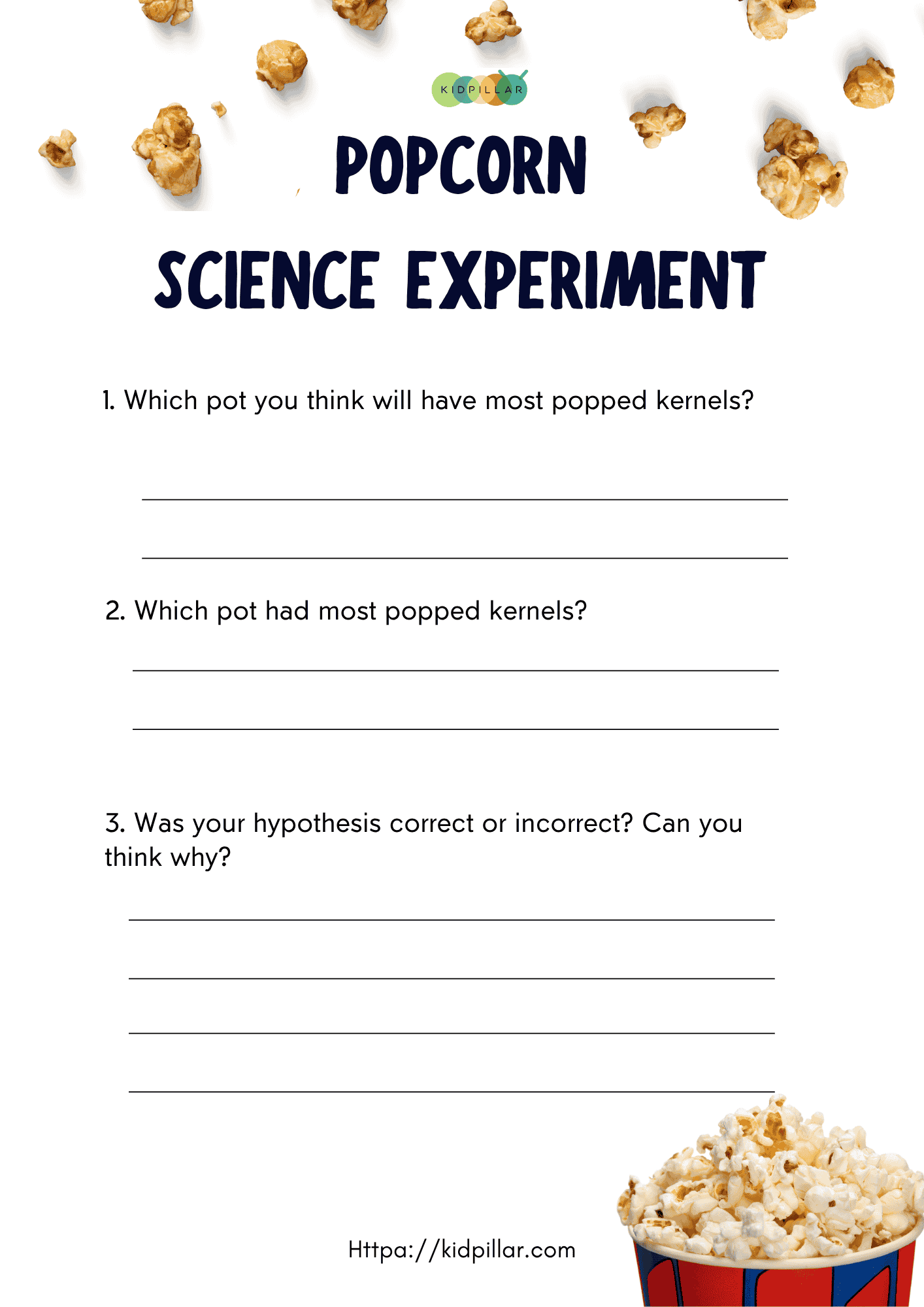
Which pot do you think will have the most popcorn? Can you guess why?
What’s going on?
On low heat, the water in the kernels slowly heats up, forming steam. This gradual heating of the water does not create a pressure high enough, 135 psig, for the case to open. Also, on low heat, steam begins to escape through the smaller vents present in the core, resulting in fewer cores popping out.
On the other hand, a strong flame quickly converts the water in the core to vapor pressure that opens the core. This is why more nuclei pop out on high heat than on low heat.
Source: Popcorn Science Experiment For Kids – Why Does Corn Pop?