
🚚 FREE DELIVERY IN UKRAINE • 📞 QUICK ORDER: +380 63 571 3650 • 📚 STEM KITS FOR HOME, SCHOOL AND CLUBS
🚚 FREE DELIVERY IN UKRAINE • 📞 QUICK ORDER: +380 63 571 3650 • 📚 STEM KITS FOR HOME, SCHOOL AND CLUBS
🚚 FREE DELIVERY IN UKRAINE • 📞 QUICK ORDER: +380 63 571 3650 • 📚 STEM KITS FOR HOME, SCHOOL AND CLUBS

What is STEM Education and Why is STEM learning Important for Kids?
At the current stage of the technological revolution, innovation has become a part of people's daily lives. From time to time
At the current stage of the technological revolution, innovation has become a part of people’s daily lives. From time to time we hear about progress in various sectors. We rarely hear about developments and innovations in education, especially in the early years of education.
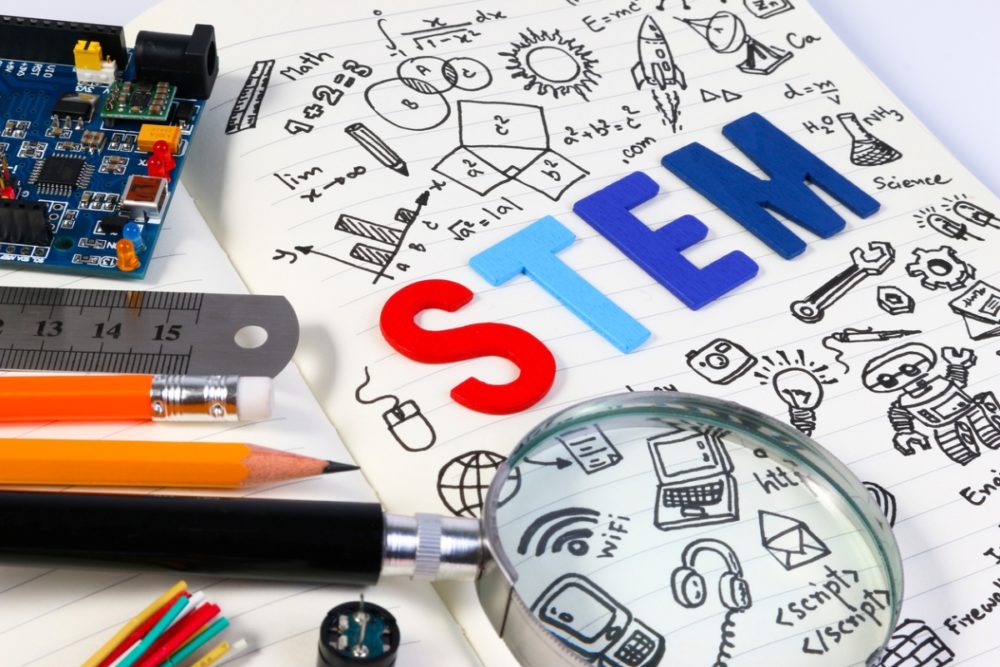
This gradually leads to a decrease in insight into learning, as traditional education is more rote learning that does not inculcate proper thinking. Recognizing this learning gap, educational researchers have proposed STEM education.
STEM education is causing a paradigm shift in early learning and aims to keep children’s curiosity and ingenuity intact throughout adulthood.
Content
What is STEM?
The term ‘STEM’ appears regularly in education policy, curriculum choice, skills sets, employment and workforce strategy. The acronym came into focus after a meeting on science education held at the US National Science Foundation.
It later gained momentum when then-President Barack Obama emphasized the need for STEM education for the United States of America to maintain its global leadership.
STEM stands for Science, Technology, Engineering and Mathematics. It is a method of teaching in which subjects are taught in a coherent manner rather than in isolation.
STEM education emphasizes bridging the learning gap by placing children at the center of the experience, making them active learners rather than passive listeners.
How is STEM education different from traditional education?
STEM is not just an acronym for science, technology, engineering and mathematics, but a method of learning that brings all these subjects together.
It removes the concern that these disciplines or subjects are often taught in isolation, when the fact is that they are all intertwined. It is a cohesive interdisciplinary approach based on hands-on learning.
In today’s world, it is impossible to distinguish these basic disciplines from each other. Pick any object from your home or office and try to fit it into any of the STEM subjects. You will see that this is impossible because everything is integrated with each other.
Science and mathematics lead to the development of technology, which is then integrated with engineering to make it useful in our lives.
STEM encourages children to experiment, make mistakes, and learn from their own experiences to achieve the right results, rather than relying on what is written in a textbook.
Critical thinking, logical analysis, inquiry, and project-based learning are the cornerstones of STEM education. This increases children’s curiosity, making the learning process fun, relevant and ongoing.
This is a paradigm shift from traditional education, which is vitally lacking in hands-on learning, to learning that is much better and deeper.
A key disadvantage of isolated learning is that students often fail to apply the concepts learned to real-world problems, which reduces their performance or understanding, and therefore implementation.
Problem. problem solving is a core skill set and is not addressed by the current education system.
If learning concerns or gaps are not addressed in the early years, the situation worsens as the level of subject complexity increases over time. This indecipherable end in basic education leads to fear for the subject that will pass ahead – all because of the inherent backwardness of traditional education.
STEM education ensures that there is no gap in understanding concepts while helping students work on applications.
Taking a very simple example for the primary years, mathematics is introduced to children with the study of numbers such as 1, 2, 3 and so on. Children do not understand why they are taught numbers and why less/more cannot be enough instead of numbers.
On the other hand, asking questions like “how much more” or “how much less” can immediately make them understand the meaning of numbers and quantification.
It is important to understand how the concepts being learned relate to the real world and how learning them will help children solve their everyday tasks. Likewise, playing board games, combining math with art and surrounding patterns, can increase a child’s understanding and interest in the subject without leaving room for anxiety.
This is how STEM learning happens for every discipline.
When to introduce STEM education to children?
STEM-based learning for children can and should begin as early as possible at the age of two. In the first years, the child’s brain treats knowledge like a sponge to water. The pace of children’s learning in the first 5 years is unprecedented and can never be the same again in life.
The correct introduction of subjects in the first years helps to form a positive attitude of children towards education. Hands-on STEM learning sets a child’s brain up for better problem solving and critical thinking, leading to metacognition and developing thinking.
Studies have shown that young children, starting school, already have sufficient knowledge about the world around them and can think divergently.
They are curious learners and have their own reasoning skills. Strengthening these innate abilities should be started at the earliest level and not postponed until later years.
Metaphorically, think of a building under construction. You cannot start building a strong, reliable building from the 5th or 6th floor.
You must start by laying a strong, solid foundation. Architects pay great attention to laying a strong foundation for the building to make the structure well-equipped to withstand harsh conditions.
If a strong foundation is laid, the upper floors or higher levels are easily reached with the same strength. The same applies to the formation of the child’s learning abilities.
By the age of eight, most children develop an interest in technology, but the transition from a user mindset to an innovator rarely occurs.
This is mainly because the education system puts more emphasis on rote learning and scoring exams, completely deviating from immersion in divergent thinking and experience. teaching.
A few years ago, NASA, in cooperation with researchers, developed a simple test to measure the level of genius of people.
The test was so simple that it could be applied to any age group from 4 to 5 years old. Below are the stunning results:
The test clearly shows that 98% of children are born geniuses, while among adults this percentage drops to 2%.
The result shows that any outstanding innovation happening around the world today is the result of these 2% adult geniuses. The rest of the population seems to just copy, or learn, or use the innovation.
Are children really born geniuses (and then get dumber)?
Children scored high on the NASA test, as mentioned above, because of their innovative or diverse imaginations. As you get older, your imagination becomes more convergent, which eventually leads to a decline in intelligence.
This decrease in intelligence is largely related to the method of learning. It becomes difficult for children to make connections between what they are learning if they cannot see the application of the concept.
The learning process is different for children before they are introduced to the traditional method of learning. Children observe, experiment and do something to adapt their environment, which ensures high efficiency of their learning.
This learning process is complicated when they are introduced to the traditional method of rote learning.
The point is that we shouldn’t mess with children’s natural learning process. We must encourage them to think, imagine, create, have their own experiences and draw their own conclusions.
What are the challenges in implementing STEM education for children in schools?
Most schools begin STEM-based education at the elementary level or later. And a lot of it has to do with robotics and programming. At this level, teachers are more prepared and trained to understand and develop this type of education with older children.
But at the preschool level, education has not evolved over the ages. One of the main problems is that teachers at this level are not trained and equipped to deliver this form of training.
STEM education is more of an inquiry-based approach where children learn through experiments and STEM activities. Children are motivated to ask several questions to deepen their understanding of the concept, making the session more communicative.
According to the study, most teachers themselves are not very comfortable exploring the practical ideas of teaching science or mathematics in an interdisciplinary way. Hence, it becomes difficult for them to undertake such an education.
A pilot project at the University of Chicago aims to understand the struggles of early childhood educators and help them learn how to teach STEM lessons.
Teachers need resources or training that can help them teach STEM and answer the questions of the inquisitive minds of this age group.
How can you teach children STEM at home?
Children spend more than 80% of their waking hours at home or under the influence of their family and friends. Needless to say, it is very important how they spend this time.
Parents play the main role in shaping the learning process of their children. Best of all, parents know their child’s inherent skills, interests, and motivational factors.
The home, with its informal setting and greater level of comfort, offers an exclusive time to deepen concepts through hands-on STEM-based learning.
Children enjoy learning much more when their parents are interested and involved in the process. This makes them extremely confident and communicative, which improves their metacognitive skills.
Quick Tip: Introduce your kids to STEM learning today with these activities, games, and ideas. Learning is a fun process, and it’s much more relevant when taught through STEM.
Why does the future of our children depend on STEM education?
If you rewind the evolution of man over the last 10,000 years, you will come to your own conclusion. It all started with hunting, gradually moving to agriculture.
After farming, we began to scale things up, build cities and craft, and eventually begin manufacturing, which marked the beginning of the Industrial Revolution.
It took us thousands of years to evolve from hunting to the industrial revolution.
The first industrial revolution started when we started using water and steam for production. Second, we used electricity to increase mass production.
The third phase of the revolution involved computers, information technology, and electronics for automated manufacturing.
Today, we are in the midst of the Fourth Industrial Revolution, where we are witnessing artificial intelligence, robotics, the Internet of Things, and things like the Metaverse that were considered impossible in previous revolutionary periods.
The speed of world evolution. over the past 50 years was unprecedented in history. Changes happen so fast that what we know or have becomes obsolete in just a few months.
Every year, companies like Apple or Samsung release at least 2-3 new versions of smartphones with the latest features.
The latest features seem so amazing that you want to ditch the previous model, which is actually only a few months old.
It’s amazing that these smartphones have evolved over the last decade to such a level that it’s hard to imagine life without them.
Similar changes occur in production processes. People feel the pace of development in every sphere of their lives.
Today, the world is ruled mainly by three companies: Amazon, Google and Meta. These are relatively young companies that emerged in the recent past.
Amazon started in 1994, Google was founded in 1998, and Meta was born in 2004. Their growth trajectory is phenomenal!
In almost two decades or a little more, they have become famous all over the world. Moreover, they are evolving every day with new features to serve the world more effectively.
Artificial intelligence (AI) or machine learning plays an important role in this.
Simply put, AI is the intelligence that humans infuse into machines based on previous experiences, actions, knowledge, and ideas.
One thing AI lacks compared to humans is cognitive skills. Surprisingly, deep neural network techniques are attempting to achieve human-level or even better performance in a variety of cognitive tasks such as perceptual, predictive, injunctive, and collaborative tasks.
Technology and innovation are fundamentally transforming the economy, and we are in the midst of the Fourth Industrial Revolution, the “Technological Revolution”.
In the future, we will witness an increase in the use of artificial intelligence and robotics, which will change business models in various sectors and regions.
According to the Manpower Group, one of the largest employment firms, advances in technology will lead to more automation, downsizing or slower hiring growth in some fields, while creating huge numbers of jobs in others.
From IBM Watson replacing lawyers at New York law firms to disease diagnostics, STEM has become a key area where new jobs are emerging, and it will continue to do so at a faster pace.
Predictions for STEM occupations:
- According to PriceWaterhouseCoopers (PwC), 75% of the fastest growing occupations require STEM skills.
- Employment in STEM occupations grew by 10.5%, or 817,260 jobs, between May 2009 and May 2015, compared to a 5.2% net increase in non-STEM occupations, according to the U.S. Bureau of Labor Statistics.
- Below are the latest employment projections for STEM and non-STEM occupations from the US Bureau of Labor Statistics. Labor statistics.
- According to the estimates above, STEM occupations are expected to grow at a significantly higher percentage than non-STEM occupations over the next decade.
- Below is a further breakdown of occupations within STEM occupations:
- The computing profession shows the largest amount of STEM. jobs thanks to continuous progress in the digital sector.
- Due to the increased participation of consumers and companies in the digital economy, exponential growth of computer-related professions is expected in the next 10 years.
- STEM workers earn much higher wages and are less likely to be out of a job than their non-STEM counterparts.
No wonder there is so much emphasis on learning to code at an early age! The above data is convincing. The world of work is undergoing changes.
For our future generations to thrive and grow, we need to embrace these changes and equip them with the appropriate knowledge and skills. The knowledge and skills that a STEM education can provide.
We are seeing changes in skill set requirements. This means that if we continue to rely on the conventional education system, at least two-thirds of children entering primary school today will not have the skills they need to get a job by the time they leave school.
Special efforts must be made to transform our education from standard traditional learning to experiential or active learning.
Which countries are seriously implementing STEM education?
The world’s leading developed countries are realizing the importance of STEM education for children at an early age.
They see early STEM education as critical to economic development and expect it to be a major driver of global competition in the future.
The United States has made STEM education part of its “Course for Success.” The US believes that the nation’s innovation, prosperity and security depend on an effective and inclusive STEM education ecosystem.
Small efforts are being made to foster interest in the fields of science and mathematics through STEM-based learning. There are many organizations and universities that support and work together to introduce STEM education at the earliest possible level.
Singapore introduced STEM education in 2014. STEM education in Singapore starts at the preschool level. The purpose of introducing the model at this early stage is to teach children to understand more complex issues later in life. Parents are pushing to enroll their children in STEM studies as early as preschool.
Nordic countries that are leaders in education are taking a more hands-on approach to learning and are even considering moving to a project-based learning approach.
STEM education in India is also gradually gaining momentum. Although still in its infancy, education departments and private organizations have begun to move up the STEM ladder.
Many schools have introduced stem disciplines at the primary level and are also targeting implementation at pre-school levels. The goal is to increase children’s critical thinking and creative skills.
Other countries such as the UK, Canada, Australia, Japan are all committed to incorporating STEM learning into the early years to get children thinking right from the start of their school years.
It has been proven that active practical learning increases the level of academic success of children. It prepares them with the right growth mindset to adapt and innovate in this fast-paced world.
Explore KidPillar STEM eBooks
FAQ
Source: What is STEM Education and Why is STEM learning Important for Kids?