
🚚 FREE DELIVERY IN UKRAINE • 📞 QUICK ORDER: +380 63 571 3650 • 📚 STEM KITS FOR HOME, SCHOOL AND CLUBS
🚚 FREE DELIVERY IN UKRAINE • 📞 QUICK ORDER: +380 63 571 3650 • 📚 STEM KITS FOR HOME, SCHOOL AND CLUBS
🚚 FREE DELIVERY IN UKRAINE • 📞 QUICK ORDER: +380 63 571 3650 • 📚 STEM KITS FOR HOME, SCHOOL AND CLUBS

Balancing Butterfly – Fun Science Experiment for Kids
Tremendous learning happens when we move from cramming to hands-on learning. This change in approach gives children
Extraordinary learning happens when we move from cramming to hands-on learning. This change in approach gives children leadership and allows them to direct the learning process and is the basis of the STEM approach to education. Instead of acting as a teacher, the adult acts as a facilitator, a guide who guides the child and helps him observe and derive answers based on existing knowledge and new experiences.
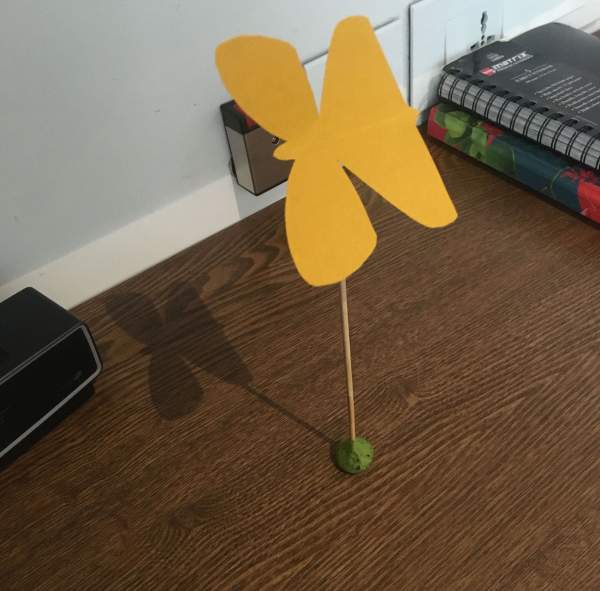
Try your hand at this fun science experiment – the Balancing Butterfly. Not only is this experiment fun, it also explores the concepts of balance, symmetry, and center of mass. Something that you and your children use in everyday life, such as when cycling or skating. Surfers, gymnasts, motorcyclists, skiers use it all the time!
For this fun science experiment you will need:
- Sheet of A4 format
- Pencil
- Scissors
- Skewer
- Clay
Step 1: Take an A4 sheet and fold it in half.
Step 2: Draw one side of the butterfly around the fold. This way your kids will understand the concept of symmetry and you will land with a perfectly symmetrical butterfly.
Step 3: Cut the butterfly along the outline with the pleat in place to get a nice butterfly cutout.
Step 4: Roll a small ball of clay and stick a skewer into it.
Step 5: Balance your butterfly on the tip of a skewer. It may take some time to find the point where the butterfly stays on the water on the skewer. This point is the center of mass of your butterfly. You can also try balancing a butterfly on your fingertip. It’s super fun!
The science of butterfly balancing
The point at which the butterfly is perfectly balanced on the tip of your finger (skewer) is its center of mass. In simple words, this means that the mass around this point is evenly distributed in all dimensions. Any object at its center of mass is balanced.
We decided to make a symmetrical butterfly to help us easily find the center of mass. For symmetrical objects, this point is easier to find and is often located along the plane of symmetry. This is how basketball players spin the ball around their fingertips.
For asymmetrical objects like a lion, it’s a little more difficult. But with a little determination, you can also easily balance a lion.
Have fun!!
READ ALSO:
Fun STEM activities to keep kids busy
Symmetry – KidPillar STEM Lesson Plan – eBook for Kids
Source: Balancing Butterfly – Fun Science Experiment for Kids