
🚚 FREE DELIVERY IN UKRAINE • 📞 QUICK ORDER: +380 63 571 3650 • 📚 STEM KITS FOR HOME, SCHOOL AND CLUBS
🚚 FREE DELIVERY IN UKRAINE • 📞 QUICK ORDER: +380 63 571 3650 • 📚 STEM KITS FOR HOME, SCHOOL AND CLUBS
🚚 FREE DELIVERY IN UKRAINE • 📞 QUICK ORDER: +380 63 571 3650 • 📚 STEM KITS FOR HOME, SCHOOL AND CLUBS

51 Outdoor STEM Activities for Kids
The outdoors has always been a fascination for children, and it's truly wonderful to be outdoors in so many ways. Combined with the exciting open
The outdoors has always been a fascination for children, and it’s truly wonderful to be outdoors in so many ways. Combined with exciting outdoor STEM activities for kids, you can easily turn a boring day into a fun learning experience.
Outdoor STEM activities for kids
Take learning outdoors with this comprehensive list of the best outdoor STEM activities for kids. Go to the section that interests you the most.
- Science for children in the fresh air
- Technology for children
- Engineering activities for children
- Mathematics for children
Research shows that outdoor activities benefit children both physically and mentally. These activities provide a great way for children to practice what they have learned and work with their hands.
With today’s declining motor skills, children need outdoor activities more than ever. Moreover, children are always looking for an excuse to be outdoors.
Science in the fresh air
1. Toothpaste “Elephant”
Elephant toothpaste easily tops the list of the funnest and easiest science experiments for kids. It produces a fluffy big foam that is sure to captivate children and make them jump for joy!
Quick Tip: Also check out Harry Potter Science Activities for Kids.
2. Cola & Mentos geyser
This is an exciting outdoor science activity for kids. Get ready to boom and explode!
Quick Tip: Not just STEM. Improve your child’s memory with these games for kids.
3. Bursting Bags
This is the quintessential outdoor science activity that every child should try. It’s easy, fast and a lot of fun for kids. All you need is a ziplock bag, baking soda, tissue, and vinegar.
Step 1. Take a napkin and pour baking soda on it. Carefully fold the napkin to reveal a bag of baking soda.
Step 2: Pour the vinegar into a ziplock bag and seal the bag, leaving a small pocket large enough to drop the bag into.
Step 3: Place the baking soda bag in a ziplock bag, quickly seal it, and run.
When the napkin is soaked in vinegar, the baking soda comes into contact with the vinegar, causing a chemical reaction. This reaction produces carbon dioxide, a gas that inflates the ziplock bag and causes it to burst.
Sodium bicarbonate + Acetic acid -> Sodium acetate + Carbon dioxide + Water
C2H4O2 + NaHCO3 -> NaC2H3O2 + CO2 + H2O
The acetic acid and sodium bicarbonate equation above explains the science of baking. reaction of soda and vinegar.
Love these bubbly science experiments? Check out the baking soda and vinegar science experiments for more fun!
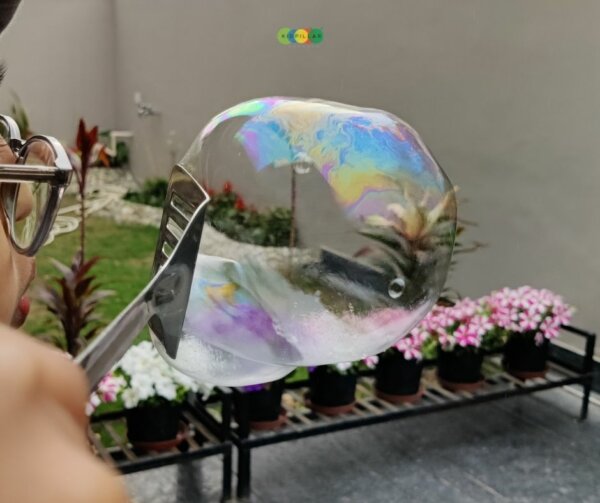
4. Make bubbles
Making homemade bubble solution is a great STEM activity that promotes many math and science concepts while having fun.
And don’t limit your kids to bubble solution. Let them also make bubble wands and learn all about the science of bubbles.
Quick Tip: Combine these fun outdoor activities with free virtual tours for kids to solve mysteries and travel to faraway places.
5. Soil science
Kids love to get dirty, and this is one activity where you won’t be complaining about the dirty spots! This outdoor science project compares different soils and how soil structure in turn affects its flora and fauna.
You will need:
- Two glass beakers
- Sand
- Garden soil
- Water
- Glass
Step 1: Pour sand into one beaker and garden soil into another.
Step 2: Take half a cup of water and pour it into both soil samples.
Observe how water penetrates through different soils. Sand allows for faster infiltration, while garden soil is able to retain water. This significantly affects the flora and fauna in the habitat.
Many of these factors affect the fauna and flora in the region. A deeper study of these factors can help overcome human-caused damage and preserve our environment.
Also, check out Rajasthan-inspired STEM activities to explore desert habitats through hands-on activities!
6. Viewing errors
This is one of our favorite activities. All you need is a bug viewer and a patch of garden.
Help your child catch a bug and watch it for a few minutes in the bug viewer. Let them count its legs, see its eyes, and observe its behavior.
Do you have a little bug lover at home? Try a fun activity with bees!
7. Human sundial
Planning to keep the kids busy all day with inexpensive, unsupervised activities? Then this is for you.
All you need is chalk and the street. The human sundial is a fascinating way to understand the Earth’s shadows and rotation.
8. Pendulum Art
This is a super fun open-ended STEAM project for kids that perfectly combines elements of art. Create abstract art with this fun outdoor science activity that demonstrates the force of gravity on an object.
9. The life cycle of plants in a pot
This is a fun entertaining game. As the name suggests, children should notice all the stages of the life cycle of a potted plant. Yes, in one pot! Sound difficult?
Well, not really! All you need is a sharp eye and good observation for this fun science activity for kids.
10. Phases of Moon Flip Book
This is one project we adore. All you have to do is click a picture of the moon at the same time, from the same place for 30 consecutive days.
Once all your images are ready, arrange them in chronological order. Staple one side and your flipbook is ready!
11. Transpiration of plants
Teach kids all about transpiration with this super easy biology experiment. Plants don’t water like we do, but then how do they get rid of all that excess water they absorb from the soil? The answer is transpiration.
Transpiration is the process by which plants get rid of excess water. But this loss of water happens imperceptibly!
Tiny holes present in plant leaves release excess water in the form of water vapor, thus making the process imperceptible.
But with this clever experiment, you can see all the water that plants throw back into the atmosphere.
All you need is a ziplock bag and a plant! Simply cover the branch of your chosen plant with a ziplock bag and seal it.
Observe in a few hours. Your kids will be amazed to see the water droplets condense along the sides of the ziplock bag, completely misting it!
Plants offer great science lessons for kids. Your child can explore their nearby garden for a variety of plant-based activities that will engage them, help them learn more about the environment, and make them natural scientists.
12. Evaporation
This is a great challenge to delve deeper into the science of matter. With this simple exercise, your kids will learn first-hand how matter changes state and how other factors affect the change of state.
What you will need:
- 3 containers with different surface area
- Water
- Measuring cup
Using a measuring cup, pour an equal amount of water into all three containers and place them in a sunny location. Observe the water in the dish after 3-4 hours.
From which vessel did the water evaporate the most? Use a measuring cup and measure the water in each container. Is your hypothesis correct?
13. Prints of the sun
This is a great activity for young children. All you need is a piece of dark colored paper and some loose pieces like blocks, clay, pebbles, etc.
These sun prints can later be used for beautiful wrapping sheets and cards.
Outdoor engineering activities for children
14. Solar oven
This is the perfect engineering project for the summer! Bake marshmallows with this easy outdoor engineering project.
The only thing you will need in abundance is patience. This is a great project for developing executive skills in children.
15. Ovoid structures
Outdoors are best suited for challenging tasks. Challenge your kids in this super messy and super fun hands-on engineering game.
16. Rockets with baking soda
17. Solar still
The Solar Still is the perfect outdoor STEM activity for younger kids. With an element of science, a little design and brainstorming, you can distill water using the energy of the sun.
You will need:
- Glass bowl
- Kipka
- Water
- Salt
- Cup
Step 1: Pour some water into a glass bowl and mix in the salt to make a salt solution.
Step 2: Place the empty cup in the center of the bowl. Make sure no salt water gets into the cup.
Step 3. Cover the bowl with cling film (plastic wrap) and leave it in the sun for a few hours.
You can place a rock in the center of the plastic wrap to create a slope for the condensed water to slide into the glass jar.
After a few hours, we noticed a few drops of condensed water on the film. Leave it for a day to collect fresh water in the cup.
The solar still is a great hands-on project for kids to learn about states of matter as well. Replace the water with ice cubes to observe all three changes of state.
18. Catapult
Catapults are loved by children. After all, who does not like to launch balls with pom-poms into the air! You can play catch-catch with this simple version of the catapult, or turn it into a street game of target for a fun night out.
19. Teepee Challenge
Invite your children to design a teepee for outdoor walks. They can use natural materials like wooden sticks, twine to make a teepee.
This is a great hands-on STEM engineering activity for elementary school kids. This is perfect for practicing geometry and spatial thinking skills.
20. Do-it-yourself bird feeder with automatic grain dosing
This self-dispensing bird feeder is the perfect activity for any nature lover. Let your child use their engineering skills to design this automatic bird feeder that requires no batteries.
21. Sundial
This is a compulsory science assignment for all children. Learn about the Earth’s rotation around the Sun with this easy engineering project for kids.
22. Do-it-yourself foil river
Children love water and nature! Combine the two with this fun outdoor STEM activity and let your child’s imagination run wild.
Hours of fun guaranteed! Bonus points for building perfect boats and winning paper boat races.
23. Weather vane
A weather vane is a device used to measure wind direction. Help your kids do this at home and observe (even on a graph!) the wind speed over a period of time. This is an exciting and relatively easy science project.
24. Pom-Pom Shooter
This is a great STEM engineering project that can be done outdoors. Made entirely from recyclable materials, the Pom-Pom shooter is a fun STEM activity that all kids over 5 will love.
25. DIY Airplane Launcher
Children love to make paper airplanes. They are an all-time classic! How about adding a twist and making an airplane launcher to blast planes out of the sky!
STEM-inspired activities
The world around us is shaped by technological inventions. Whether it’s a spaceship or your phone, it’s all about technology. It is an integral part of our lives.
Doing technological STEM activities with children help them explore and use technology in a safe environment.
Instead of viewing technology only from the perspective of entertainment, children can learn how to solve problems using technology. This is an important step in changing their perception and interest in technology.
26. Coding
Make the most of your screen time by helping your kids learn to code at home with coding and coding websites for kids.
These coding apps and websites for kids are very interactive and fun. They are the perfect virtual learning resource for young children learning basic programming skills and teenagers developing their coding skills with text-based coding.
27. Identify birds using the program
Take your love of nature a step further with a bird watching app. Any child can be turned into an ornithologist with a Merlin Bird ID. It’s a great way to use technology to understand the local habitat and the birds in it.
28. Hunt QR Code
A QR code is basically a square graphic of small black squares and dots. It contains information like web address and link.
QR codes simplify the process of browsing by directly landing the user on the link embedded in the QR code instead of typing it. All you need to do is simply scan the QR code.
On your next trip to the mall or supermarket, teach your kids all about QR codes and ask them to identify them at the supermarket. Many payment programs use QR codes.
Help them identify products and services that use this technology. Ask them if they can create a QR code and what information they would like to put in it.
Such actions broaden your children’s perception. Instead of looking mindlessly at technology and apps, children engaged in such activities become curious and more likely to learn about the technological landscape.
29. Plant detectives
Help your little botanists explore the flora around them with a cool plant identification app. There are many free options available for both iPhone and Android users.
This STEM activity is just perfect for beginning gardeners who are just learning about the plants they can add to their garden.
30. Track your trip with Google Maps
Help your kids explore their neighborhood with Google Maps. As they familiarize themselves with the program, have them map their friend’s house and compare alternative routes.
31. Natural refrigerator
This is a great tech summer project for kids. The task is to create a natural refrigerator. What you will need is an Earthen Pot and regular water bottle.
Step 1: Fill the earthen pot and water bottle with water at room temperature.
Step 2: Dig a hole big enough in your garden to bury the earthen pot while keeping its neck above the ground. Place the water bottle next to the pan.
Step 3: After 4-5 hours, check the temperature of the water from the clay pot and the bottle. Which one is colder?
This is one easy way to create a natural refrigerator. Lower layers of earth are cooler than the topmost layer and the porous nature of earthen pot allows heat exchange.
Burying an earthen pot underground exposes the water to a lower temperature environment and the porous nature of the earthen pot further facilitates the heat sink, thus, cooling the water in the pot.
32. “Night Sky” application
Take your child on a journey into space and explore celestial objects with the Night Sky app. Help them identify the planets in the night sky and discover the constellations.
33. Water wheel for children
The water wheel is a great science project for kids about natural resources and green energy. A water wheel is a simple machine that converts the energy of falling water.
For a simple demonstration at home, simply pour water onto a water wheel and watch the energy of the falling water transform into motion.
34. Make a compass
Another great outdoor STEM project for kids. This one teaches world directions using a compass (or vice versa!)
35. Create a complex machine
A compound machine is a combination of two or more simple machines. This easy to make compound machine is great for a summer science fair project and employs two simple machines – Pully and Wheel & Axle.
What you will need:
- 4 Paper Plates
- Black Acrylic colors
- Pencil
- Glue Gun
- Yarn
Step 1: Paste two paper plates together on the edges so that they are facing each other. This will be the wheel for the project. Make another wheel using the other two paper plates.
Step 2: Paint the paper plate wheels black with acrylic paint and let dry.
Step 3: Mark the center on both wheels.
Step 4: Sharpen the pencil at both ends and glue it in the center of the wheels. Secure the knot with a glue gun. The pencil will act as an axle.
Step 5: Tie one end of yarn/twine around the pencil, wrap it enough number of times and leave one end free to pull.
When pulled form the loose end of the yarn, pencil and yarn will act like a pulley. Since the pencil also acts as an axle, it will transmit motion to the wheels that will move our folded machine.
36. Do-it-yourself magnifying glass
How about exploring the garden and its millions of wonders with a DIY magnifying glass? Exciting, really! Use simple recycled materials around the house to make this magnifying glass.
What you will need is:
- Plastic Bottle
- Marker
- Blue Gun
- Cardboard
- Cutter
Step 1: Draw two equal circles on the neck of the plastic bottle and cut them out using a cutter.
Step 2: Using a glue gun, glue the plastic circles around the edges, leaving a 1-inch gap to create a convex knot.
Step 3: Pour water into the glued circles through the gap, then seal the gap with a glue gun. This will act as a magnifying glass.
Step 4: Cut two rectangular strips of cardboard for the magnifier handle. Using a glue gun, glue one end of the strip to both sides of the magnifying glass. It is optional and more so for younger children. Older children can use the homemade lens as is.
37. Make your own thermometer
Make your own thermometer at home and measure the temperature outside at different times of the day. This is a great summer project for kids to get them interested in weather science.
38. Scavenger hunt in nature
There is nothing more exciting than an outdoor scavenger hunt. Give your child a camera along with a list of things to observe and let the fun begin!
This activity will not only teach children how to use a camera, but also introduce them to the science of light and optics, improving their observation skills.
39. Dirt Battery
Do you have a young techie who wants to try their hand at all kinds of things? Look no further! The Dirty Battery is a great hands-on project to get your kids started with batteries.
Outdoor STEM math activities
40. A burst of numbers on a balloon
Make math fun and silly with this easy math activity for kids with a balloon number burst. This is a simple practice activity to teach children about number recognition, counting and counting odd and even numbers.
You need water balloons and chalk. With the help of chalk, draw several circles and write numbers in them. Name the number and let the child aim the water balloon at it. Perfectly!
These fun ways to learn and practice math can help get kids interested in math and say goodbye to math anxiety forever!
Similar: Also check out these 10-minute number games to develop mental math and early numeracy skills in a fun way.
41. Roll, Count & Move
This is a great game for developing gross motor and counting skills. Perfect for a cool evening in nature.
42. The game “Clock on the sidewalk”
Study time will be a breeze with this outdoor math activity. Children learn much better in the fresh air and with the help of game methods. It’s both!
43. Hula Hoop Venn Diagrams
Take your sorting skills to the next level in this super fun game. The task is to separate the elements into appropriate groups, to create a relationship (eg union, intersection), but not to get bored with the worksheet!
44. Hop and jump
This is a great outdoor math activity that’s perfect for little monkeys who love to jump. There is no better way to teach skip counting than this.
You need to draw several circles and write in them, but in any order, count with gaps.
For example, if you do a skip of 3, you can have circles of 3, 12, 6, 21, etc.! Your child must jump from circle to circle following the correct sequence of numbers. What a pleasure!
For more math games, check out Math Card Games for Kids to make learning math practical and fun!
45. Mathematics in the web
Now outdoor math isn’t just for younger kids learning to recognize numbers and skip counting!
Make a web and get ready for some serious outdoor math fun. It’s a fun mental math exercise for kids that also gets them jumping.
Make a large web on your side and write the numbers in each part. Call out commands like 5+4, 10-8, 12+6, etc. Your child has to mentally deduce the answer and choose the correct number.
46. Pattern Hunt
This outdoor math activity is perfect for those lazy days when moms just want to sit back and relax. Ask your child to walk around the garden and find as many different patterns as possible.
Leaves, flower petals – all have certain patterns! Remember how Fibonacci stumbled upon the famous sequence!
Explore Patterns for Kids with KidPillar’s STEM eBook to lay a strong foundation for early math skills.
47. Run and Round
This outdoor math activity helps kids practice their skills in a fun way. Just randomly write some numbers on your sidewalk, but be sure to add consecutive numbers to make the game challenging.
Now say the number and ask your child to round it to the nearest place and go to the correct answer. Start by practicing simpler numbers and then introduce more complex numbers with a higher decimal value.
48. Spot tessellation
Mathematics is everywhere! Ask your child to notice higher patterns, such as tessellation around. Places of worship, restaurants, and sidewalks are great examples of tessellation.
49. Sidewalk Math Facts
Help your child practice basic operations and math facts with this great sidewalk math game. You’ll be surprised how much fun math practice can be!
50. Geometric pattern with sticks
Use natural materials and give wings to your child’s creativity with stick patterns. Your child can start with an easier pattern and then gradually progress to a more complex one. Let your lawn/backyard be her scrapbook.
51. Leaf chart
Wondering how to introduce a child to the idea of a square? This is one simple task that will make a slightly advanced area concept suitable for children aged 6 and up.
Choose a variety of leaves from your garden and trace them on graph paper. Ask the child to count the squares within the outline of the leaf.
Suppose that each square corresponds to 1 sq. area inches. The number of squares on the sheet is approximate to the area of the sheet. To add complexity, count the squares with the outline and break them down to get about 1 square. inch.
52. Build a My Yard graph
Work on data skills with this fun math activity for kids. Have your child scroll through the garden for 15 minutes and then graph their observations, such as the number of fallen leaves, flowers, bees, etc.
This is a simple but very effective lesson in data processing.
53. Kindergarten mathematics
You can practice measuring skills in the fresh air. Let your child explore a neighborhood garden or your own vegetable garden to measure leaves, flowers, and fruits.
You’ll be amazed at the diversity of a small garden and the many science and research activities you can do in your backyard.
Encourage your kids to grow some plants by planting the seeds exactly 2 inches under the ground. This is a great activity to encourage hands-on measurement.
This huge list of outdoor STEM activities will encourage your children to observe their surroundings and invent their own ideas for games. Thus enhancing their STEM skills while keeping them fit.
No more boredom!