
🚚 FREE DELIVERY IN UKRAINE • 📞 QUICK ORDER: +380 63 571 3650 • 📚 STEM KITS FOR HOME, SCHOOL AND CLUBS
🚚 FREE DELIVERY IN UKRAINE • 📞 QUICK ORDER: +380 63 571 3650 • 📚 STEM KITS FOR HOME, SCHOOL AND CLUBS
🚚 FREE DELIVERY IN UKRAINE • 📞 QUICK ORDER: +380 63 571 3650 • 📚 STEM KITS FOR HOME, SCHOOL AND CLUBS

Shark Awareness Day – Learn, Protect & Conserve
July 14th is Shark Awareness Day - a day to go beyond the conventional wisdom about these magnificent creatures,
July 14th is Shark Awareness Day – a day to look beyond the conventional wisdom about these magnificent creatures, learn how important sharks are to the oceans, research the facts about sharks, and most importantly, raise awareness to help save sharks from extinction.
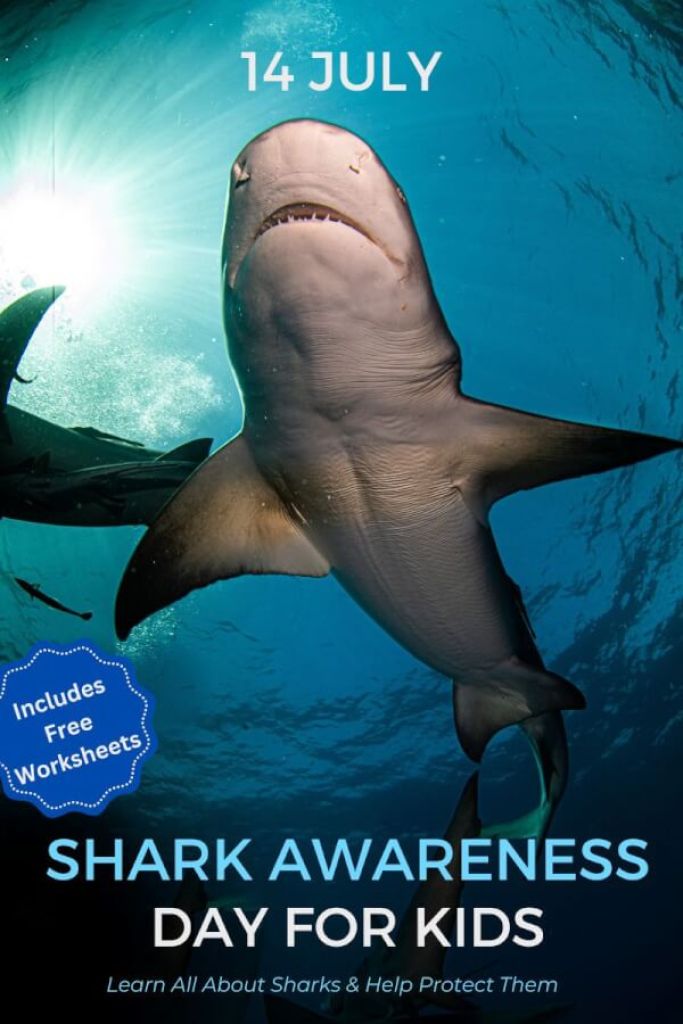
Sharks have long been advertised as terrible killers and even cannibals. But this is far from reality.
Truth be told, they fear humans as much as humans fear them! Also, we pose a much greater threat to sharks than they do to us.
The chance of being attacked by a shark is approximately 1 in 11.5 million, while on the other hand, humans are estimated to kill around 100 million sharks annually!
- Why are sharks important to the oceans?
- Why are sharks important Endangered?
- Interesting facts about sharks
- Types of sharks
- Books about sharks for children
- Printable Shark Awareness Day
So, contrary to popular belief, math just doesn’t work for these defiled creatures. This baseless fear of sharks was fueled by movies and mass media!
Learn all about sharks and print out the free Shark Awareness Day worksheets (at the bottom of the page) to get your kids involved in saving these ocean masters.
Why are sharks important to the oceans?
Sharks are an indispensable piece of the puzzle of the marine ecosystem. and they simply cannot be thrown away.
These apex predators have several natural enemies. Contrary to what it seems at first glance, sharks play a large role in maintaining the food web. As a top predator, they play a role in maintaining the delicate balance of the marine food web.
A decrease in shark populations will lead to an unnatural increase in the population of their prey, which in turn will affect aquatic animals further down the food web, and ultimately adversely affect seagrass habitats and coral reefs. Thus, the entire marine food chain is disrupted.
Removing sharks from the marine ecosystem is thought to negatively impact seagrass beds, which are important for their ability to absorb carbon from the atmosphere and help combat climate change.
In addition, sharks are also critical to the health of the marine ecosystem. They keep the ocean healthy by preying on the old and sick, thus helping to prevent the spread of disease and maintain a healthy gene pool.
Shark Awareness Day aims to shine a light on the vital role sharks play in supporting our oceans and raise awareness for their conservation and protection.
Why are sharks endangered?
Unfortunately, humans are responsible for the decline in shark populations. Increasing human activity, habitat destruction, ocean pollution, and the overwhelming demand for shark fins and teeth have led to the depletion of certain shark species to such an extent that they are now listed as endangered, and some are even on the brink of extinction.
They are often bycatch and end up entangled, or at worst, suffocated in commercial fishing nets.
Besides. Fishing, bait drums and shark nets also kill sharks, especially young sharks who are more likely to suffocate.
With such a scenario, raising awareness and educating people, especially the youth, about this most popular predator can bring about a positive change.
20 interesting facts about sharks
This Shark Awareness Day, create intrigue by sharing amazing shark facts! These fun facts about sharks will surprise everyone and get your kids interested in these fascinating ancient creatures!
After all, raising awareness about sharks and learning about these magnificent creatures is a great way to protect them.
1. Sharks survived the dinosaurs that roamed our planet almost 200 million years ago and are one of the oldest animals on Earth. These graceful creatures have been around for over 400 million years, and for good reason!
2. Sharks come in different shapes and sizes. There are about 520 different species of sharks, each with a different temperament.
3. There are no bones in the body of sharks. These are cartilaginous fish, that is, their skeletons are made of cartilage, not bones. Your nose and ear are also made of cartilage.
What does the human skeleton consist of? What other systems does our body consist of? Learn all about The Human Body eBook!
4. They have excellent vision and can see very well even in low light. This helps them easily spot their prey at night.
5. Unlike other fish that have scales, shark skin is tough and covered with tooth-like structures called denticles.
6. The whale shark is the largest shark and also the largest fish. It can reach 50 feet in length and weigh about 20 tons.
7. Sharks have electroreceptor organs that allow them to sense temperature changes and electromagnetic fields in the oceans.
8. Most sharks are excellent swimmers and can swim at a speed of 32 to 40 kilometers per hour.
9. Sharks have an excellent sense of smell, which helps them identify prey at great distances.
10. Whale shark spots are as unique as human fingerprints.
11. A baby shark is called a cub and becomes independent as soon as it is born.
12. Sharks differ from each other in the way they reproduce. Some give birth to live young, while others lay eggs.
13. Sharks go into a trance or sleep-like state when flipped over.
14. At the same time, sharks have about 3000 teeth, divided into 5 rows. They also lose up to 100 teeth per day.
15. Must-have ram sharks include the great white, mako, and whale shark. They never rest and are forced to keep swimming their entire lives.
Continuous swimming allows water to pass through their gills and deliver oxygen to the blood. If these sharks can’t swim, such as when they get caught in fishing nets, they can die of suffocation.
16. Some sharks sleep with their eyes open, while part of their brain wakes up (unihemispheric sleep) to avoid drowning. They are not the only animals with strange sleeping habits.
17. Whale sharks have an estimated lifespan of about 150 years, while smaller sharks live between 20 and 30 years.
18. In most sharks, the upper part of the body is darker, and the lower part is lighter. This helps them blend in, camouflage themselves in ocean waters. Camouflage helps them stay hidden and catch prey.
Learn How Animals Play Hide And Seek With Camouflage eBook!
19. The chain catshark and the puffer shark are biofluorescent, meaning they glow in the dark.
20. The smallest shark is the pygmy lantern shark, its size is only 19 centimeters.
Also read over 200 fun facts for kids to surprise your kids!
Types of sharks
As for the number of shark species, we don’t have a firm figure! According to the latest data, about 520 types of sharks swim in the oceans.
Here we highlight some of the most impressive ones that are sure to pique everyone’s interest.
1. Whale shark
These are the largest sharks and the largest fish. Whale sharks are spotted, and each whale shark has its own unique pattern of spots.
They live in the warm waters of the Indian, Atlantic and Pacific oceans. Despite their enormous size, these creatures feed on tiny plankton and filter feeders.
They give birth to live young that are only 16 to 24 inches long at birth.
2. A large shark
These gentle giants are the second largest sharks that swim in our oceans. Like whale sharks, large sharks are also filter feeders.
They swim with their mouths wide open and seem to bask all the time, hence the name large sharks.
Found in all the world’s oceans, these docile fish prefer cold temperate waters to warm waters.
3. Great white shark
These large predators are found in all oceans. Great whites are inherently interesting and have a formidable image as the most feared predators in the ocean. However, even these terrible creatures are afraid of the formidable killer whales.
They can grow up to six meters long and weigh over 4,000 pounds. These sharks are excellent swimmers with an unparalleled sense of smell that allows them to smell prey even two miles away.
4. Mako shark
Found in tropical and temperate seas, mako sharks are ferocious predators and the fastest sharks.
These fast swimmers can grow up to 14.5 feet and weigh up to 500 kg. There are two types of mako sharks – the long-finned mako shark and the short-finned mako shark.
5. Bull shark
These large sharks are notorious for their aggressive behavior. They are characterized by their blunt snout and can adjust their body to live in both fresh and salt water.
This makes them unique among shark species. These fearsome sharks can grow up to 11.5 feet and weigh almost 500 pounds.
6. Tiger shark
Tiger sharks live in tropical and subtropical waters around the world and are voracious hunters, just like their land-based namesakes.
The name tiger shark comes from the tiger-like stripes on the bodies of their young. However, as these sharks grow, these stripes almost disappear.
Aggressive and built for the kill, these sharks can grow up to 14 feet long and weigh nearly 1,400 pounds.
7. Hammerhead shark
One of the most distinctive looking sharks, hammerhead sharks can be easily distinguished by the shape of their heads.
These talented hunters use their hammer-shaped heads to scan a wide swath of the ocean at once as they hunt.
Found in all warm and tropical zones, these creatures can grow up to 20 feet and weigh nearly 1,000 pounds.
8. Thresher sharks
Thanks to the long tail fin of thresher sharks, they can be unmistakably identified. The tail fin, which is almost half the length of the body, is used by thresher sharks to stun and collect prey.
There are three types of thresher sharks – the common thresher shark, the pelagic thresher shark, and the bigeye thresher shark.
These sharks are known to migrate to tropical and subtropical waters. temperate waters for hunting.
9. Blue sharks
The name blue shark comes from their coloring, which is unique to the shark species.
These beautiful, stunning creatures have a dark blue back, lighter blue sides and a white underside.
These open ocean bigeye sharks are migratory in nature and are found in the temperate and tropical oceans of the world.
10. Brown striped bamboo shark
These relatively smaller sharks are found in shallow water and are nocturnal. These sharks get their name from the distinct dark and light stripes on their bodies.
As with tiger sharks, these stripes are more pronounced in juveniles and disappear as these sharks grow.
Printable Shark Awareness Day
A great idea to get the kids to really absorb what they’ve learned about these wonderful creatures and get them involved through fun Worksheets.
These Shark Awareness Day worksheets for kids are fun to do and get kids thinking by encouraging them to take small actions that can have a big impact.
Shark worksheets
Frequently asked questions
This post may contain Amazon affiliate links, which means I earn a small (< 5%) commission on your purchase.