
🚚 FREE DELIVERY IN UKRAINE • 📞 QUICK ORDER: +380 63 571 3650 • 📚 STEM KITS FOR HOME, SCHOOL AND CLUBS
🚚 FREE DELIVERY IN UKRAINE • 📞 QUICK ORDER: +380 63 571 3650 • 📚 STEM KITS FOR HOME, SCHOOL AND CLUBS
🚚 FREE DELIVERY IN UKRAINE • 📞 QUICK ORDER: +380 63 571 3650 • 📚 STEM KITS FOR HOME, SCHOOL AND CLUBS

40 Best Science Experiments for Kids
The best way to teach children science is through experiments. Science experiments for kids improve understanding
Experiments are the best way to teach children science. Science experiments for kids enhance understanding of concepts and their real-world applications, further instilling the roots of STEM learning for kids.
Trying to understand science by simply reading it is not only boring, but also very ineffective. Both physical and mental involvement are extremely important, especially for young children. And the best way to do that is to enjoy DIY science experiments!
- Science experiments for children
- Safety rules for science experiments for children
But before plunging into the exciting world of practical light science experiments for children and preparing for all exciting science activities, it is worth setting aside space for the science of intelligence. Even a small room can be enough to become a home science laboratory for children!
By setting aside a space for science experiments, you will keep your home free of clutter and give your child a safe space to explore and unleash their creativity.
Using a science lab and kid-friendly lab equipment has a positive effect on learning and engagement, creating neural pathways that lead to better learning and retention.
In addition, a home science lab for kids and kid-friendly lab equipment ensure their safety while they are busy with their science experiments.
“Tell me and I’ll forget
Teach me and I can remember
Get me involved and I’ll learn”
~ Benjamin Franklin
Our great list of kid-friendly fun science experiments for kids to do. at home with supplies readily available and full of wonder! Let’s get started…
Related: Gamify Math with These Fun Kindergarten Math Games
Science experiments for children
1. Bubble Towers
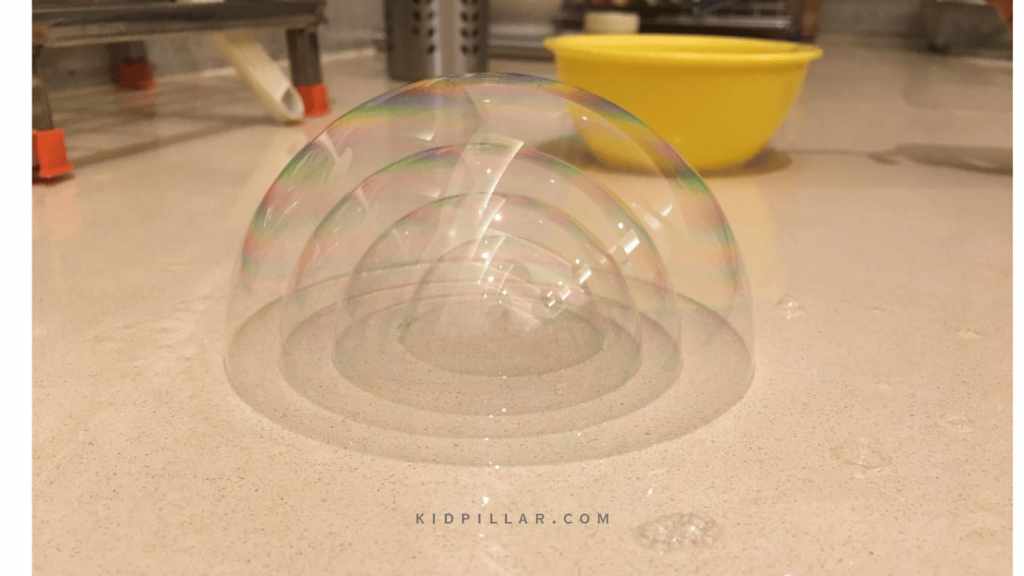
The Bubble Towers science experiment is a super hit not only for children, but also for adults. A great boredom buster, this is one experiment that will captivate your whole family.
This is a great surface tension exercise for kids. Also, they can spot rainbows above their bubbles.
What you will need:
- Bubble Solution – Make homemade bubble solution with this easy bubble solution recipe
- Straw
How to make towers from bubbles
Step 1: Clean the kitchen counter (or any smooth surface) so that it is free of dirt. This is very important to prevent soap bubbles from bursting.
Step 2: Pour a tablespoon of the bubble solution onto the cleaned counter and spread it out.
Step 3: Dip the tip of the straw into the bubble solution and blow onto a clean, soapy counter, holding the straw close to the surface.
Make it big enough to fit another bubble inside. it.
Step 4: This step will require some patience. To insert a smaller bubble into a larger one, dip the straw back into the bubble solution, poke it through the larger bubble, and blow into it to create a smaller bubble inside.
With a little patience and practice, you can make your own bubble towers. After several trials, we managed to get a tower of four bubbles.
Looks like: Combine these DIY science experiments with fun indoor activities for kids at home to help your kids relax.
2. Toothpaste “Elephant”
One of the funnest science experiments for kids. “Elephant” toothpaste never disappoints children (and adults!). It’s just the perfect experiment to get kids interested in science.
Related: Check Out Science Experiments for Preschoolers—For Little Inquisitive Minds.
3. Lava lamp
A science experiment with a lava lamp is always a big hit with children. Whether you have a preschooler or an older child, this experiment never fails to amaze and is a great way to teach science in a hands-on way!
Easy on the pocket and quick to set up, it requires commonly available pantry materials. Definitely worth a try!
Quick Tip: Combine these science activities with Home Preschool Activities to make learning literacy, math, art, and motor skills hands-on and easy.
4. Huff and Puff
Take a rectangular piece of paper and fold it in half widthwise. Now place it on the table like an inverted V. Blow the paper.
What will happen? Magical, right?
Just a great science activity to impress your kids and friends!
Add a generous dose of humor to take learning to the next level with these science jokes and puns! Or, if your child is a math geek, puzzle them out with Funny Math Puns.
5. Ice cream in a bag
How about taking a transfiguration class at Hogwarts to learn some magic? We children, not you! A science experiment with ice cream in a bag is real magic. It turns simple ingredients like milk and sugar into delicious ice cream in 15 minutes.
Related: Looking for a magical science activity? Check out Harry Potter STEM Activities & Science Experiments.
6. Sticky water
What happens if you turn a glass of water upside down? It falls, doesn’t it?
Make water stick to glass with this amazing, easy-to-do science experiment for kids. Take an old playing card or cardboard big enough to cover the neck of the glass.
Fill the glass with water and cover it with cardboard. Pressing firmly on the card, turn the glass upside down in one quick motion.
Now withdraw your hand without touching the card. Water will not fall, but will stick to glass and cardboard.
Quick Tip: Combine these cool science experiments with fun memory games for all-around development.
7. Magic milk
It’s endless fun, although it does lead to milk loss. So, you can be careful.
Pour some milk into a wide bowl. Add the food coloring to the milk using a dropper…you might want to use different colors for best effect.
Now take a cotton swab and dip the end of it in dishwashing detergent. Tap this hint on the milk.
You will be amazed to see what happens. No wonder everyone loves this easy science experiment for kids!
Looks like: Combine these fun experiments with educational and fun activities in kindergarten to sharpen your child’s skills.
8. Jumping naked egg
Turn an ordinary egg into a bouncy ball with this easy science experiment for kids. When dropped from a short height, this rubber egg will bounce like a ball and not burst!
Such a fun science experiment for kids of all ages!
9. Balloon amplifier
All you need for this science experiment is a balloon. Blow up a balloon and tie it with a knot. Ask your friend to make a finger-snapping sound.
Now holding the balloon to your ear, ask your friend to make the same sound on the balloon. This time you will be able to hear it louder.
Quick tip: Liven up your conversations with Fun Science Trivia for Kids.
10. Floating eggs
This is a really cool experiment that impresses children every time. Take a tall glass and pour water into it.
Drop a raw egg to see if it floats. Any normal fresh egg will sink to the bottom. Can you make the same egg float?
Try this. Remove the egg from the water and set aside. Add about 5-7 tablespoons of salt to the water and stir until it dissolves.
Now put the egg in this salt water and see what happens – it floats!!
Quick Tip: Be sure to add Funny Science Riddles!
11. Make your own soda
Have you ever wondered how manufacturers add bubbles (fizz) to their sparkling water? Well, you can do it too. All you need is a lemon, baking soda and some water.
Squeeze lemon juice into a glass. Add water to the juice in the same amount as the juice. Do not dilute too much.
Finally, add a teaspoon of baking soda to the mixture and stir. See that fizz? Your own sparkling water is ready!!
Like this baking soda and vinegar experiment? We have a lot more here…
12. Do-it-yourself electromagnet
This fun and easy science experiment turns an ordinary iron nail into a magnet using simple materials. It will surely engage children, turn on science and teach children how to make an electromagnet at home.
13. Witch’s Cauldron
All children love this game. All you need is dry ice and hot water.
Take a pot that looks like a cauldron. If you do not have it, take any container at your discretion. Place dry ice in a container and fill it with hot water.
Be amazed as the cauldron begins to bubble and release clouds of mist. We’re sure adults will enjoy this science experiment just as much as kids!
And it’s just the perfect Halloween science activity.
14. Dancing Stick Man
This is a simple science experiment for kids at home that can keep them busy for hours! All you need is a glass plate and a dry erase marker.
Draw a stick man on the plate with a dry erase marker. Pour water onto the plate and gently swirl it. Watch your rod dance as the water churns.
15. Floating paper clip
This is a great science experiment for kids, but it can take some practice to get it right. Take a paper clip and try to drop it into a bowl of water. He will drown.
Now take a piece of sticky tissue paper about 3”X2”. Gently place the napkin on the surface of the water. Carefully place the paper clip on the napkin without disturbing the water.
Here’s the tricky part. Using a pencil with a rubber band at the top, try pushing the tissue through the water with the end of the rubber band.
After a few tries, the paper towel will sink, leaving the paper clip floating on the surface.
16. Oobleck
This easy science experiment for kids was inspired by Dr. Seuss. Oobleck is a strange mixture that differs from the properties of solids and liquids.
If you stir it, it will become liquid and flow. Punch it, it will act as solid. Take it in your hands and press it between your fingers…it will harden and when you let go it will flow like water.
Make your own quicksand at home and teach your kids a hands-on, brain-teasing lesson about the states of matter.
Related: Also make Color Changing Oobleck at home with kitchen ingredients for a magical experience.
17. Dancing ghost
This fun science experiment is sure to scare your kids in a fun way! Take a facial tissue and cut a small ghost shape out of it.
Be sure to use one layer of tissue paper. The lighter the paper, the better it is. Using the market, make creepy eyes on the ghost cutout.
Then inflate the balloon and tie it. Rub the balloon quickly through your hair for about 20 seconds. Bring this balloon close to the ghost.
You will see your ghost fly towards the balloon. Really creepy!
How is everything creepy? Explore some not-so-scary ghost facts for kids to get their hearts racing.
18. Make a rough junk
Make disgusting snot with this easy science experiment for kids and let your kids have some dirty, dirty fun.
To make fake junk, you’ll need gelatin, corn syrup, and boiling water. Add three teaspoons of gelatin to half a cup of boiling water.
When the mixture starts to cool, stir it with a fork. Add a quarter cup of corn syrup to this mixture and stir with a fork.
Now snot will begin to form. Add water when the mixture has cooled and stir to get the desired consistency. Scare your friends with this fake, bad snot!
19. Make lighting at home
This is a science experiment we all did as children. All you need is a dark room and a blanket, preferably velvet or fur.
Invite the child in a blanket into a dark room. Have them quickly rub their nails against the blanket. They will be able to see the sparks… it’s lightning!
20. Keep the paper dry under water
A really fun water science experiment for kids that only requires paper, a clear bowl, and a glass. Ask your children if they can keep the paper dry in the water.
Take the challenge and show them how you can keep paper dry in water. Crumple up a piece of paper and place it on the bottom of the glass.
In a quick motion, lower the glass to the bottom of the container of water, keeping the glass upright the entire time.
Take out the glass and check the napkin – it is completely dry!
21. Wash away the germs
Teach kids the basics of hand hygiene with this super fun Wash Out Germs experiment.
This easy science experiment for kids will be a hit with the kids (band parents!) as they really get to see the magic of the 20 second hand washing rule.
According to this golden rule, you should rub your hands with soap for at least 20 seconds to get rid of all germs.
But kids are always in a hurry, and this experiment teaches them how the 20-second rule works and why they should stick to it.
What you will need:
- Plastic glove
- Dry erase markers
- Soap
- Water
- Elastic band
How to do it:
Step 1: Take a plastic glove, blow it up like a balloon and tie it around its mouth.
Step 2: Draw some germs randomly on the glove with an erasable marker.
Step 3: Ask the child if she/he can wash the germs off the glove with soap without following the 20 second rule. Are germs still present?
Step 4: Try washing the glove again, just washing it well with soap and counting to 20 this time. Boom! The germs are gone.
Looking for more fun ways to teach kids about hygiene? See hygiene measures for children.
23. Blow out your jack-o-lantern
This is a clever chemistry experiment for kids that is super easy, takes less than 5 minutes to set up and is always a hit with kids.
What you will need:
- Empty plastic bottle
- Baking soda
- Vinegar
- Black marker
- Orange balloon
- Crater
How to do it:
Step 1: Using a black marker, draw your flashlight’s eyes and mouth onto the orange balloon.
Step 2: Clean a plastic bottle and fill it one-quarter full with vinegar.
Step 3: Place a watering can into the balloon hole and add one tablespoon of baking soda. Twist the neck of the balloon to secure the baking soda inside.
Step 4: Carefully insert the balloon neck into the bottle cap and untwist the balloon.
When the baking soda enters the bottle, it reacts with the vinegar, starting a chemical reaction and creating carbon dioxide attacks.
This gas rises up. and inflates the balloon, bringing your jack-o-lantern to life.
23. Do-it-yourself sundial
A sundial is a great math and engineering activity to do with kids. With some basic materials and a bright sunny day, you’re ready for this hands-on STEM activity.
What you will need:
- Cardboard
- Paper for needlework
- Pencil
- Weight
- Clay/dough
- Glue
How to make a sundial:
Step 1 : Draw a large circle on art paper and cut it out with scissors. This will be your watch face.
Step 2: Glue the dial to the cardboard to create a strong base.
Step 3: Insert the pencil into the center of the dial and secure it with clay or dough. Make sure the pencil is upright.
Step 4. Now place this arrangement in a sunny location where you expect to see sun all day.
Step 5: Using a pen and scale, mark the pencil shadow on the dial. Write the hour that corresponds to the shadow.
Step 6: Once this is done, you should mark the shadow that corresponds to each hour on the clock. We used a timer to help us stay on track.
By the end of the day, you should have at least six markups. These marks can then be used to draw the other half of your sundial.
That’s it! Your sundial is ready! Pay attention to the spaces between the marks. Each interval represents an hour on the sundial.
Put your sundial in the same place in the sun, you can tell the time by looking at the shadow of the pencil.
24. Sink or swim
Experiment with buoyancy with this simple and easy science project. This sink or swim science experiment for kids is a great way to demonstrate how air helps objects float.
What you will need:
- 2 oranges
- Water
- A tall glass vessel
How to do it:
Step 1: Fill a glass container three-quarters full with water.
Step 2: Peel the orange and place it in a bowl. This will sink to the bottom of the flask.
Step 3: Next, place the unpeeled orange in a flask of water. This orange will float.
By common logic, an unpeeled orange should float because it’s lighter! But in this case, the lighter object sinks! Why?
Well! Cool science is at play here. Orange peel is porous and contains many air pockets that give it the buoyancy it needs to float.
When an orange is peeled, these air pockets are removed, so the peeled orange sinks. So cool!!
25. Chromatography of leaves
This is a simple science exercise with kids to get them interested in plants.
Chromatography is a scientific technique used by chemists to separate two or more substances present in a liquid.
This science experiment for kids is an easy demonstration of the color pigments present in leaves and requires materials readily available at home.
You will need:
- Pencil
- Cup
- Scotch
- Alcohol
- Water
- Scissors
- Kitchen paper towel
How to do it:
Step 1: Take a leaf and grind it to make a paste.
Step 2: Make a 1:1 solution of water and alcohol in a cup. Mix the paste from the leaves in the solution.
If you don’t have alcohol, you can use nail polish remover with a higher concentration in the solution.
Step 3. Cut a long strip of kitchen paper towel with scissors.
Step 4: Wrap the paper towel around the middle of the pencil so that one end of the kitchen paper towel hangs loose.
Step 5. Place the pencil on the cup so that the free end is immersed in the solution. Do not immerse the paper towel more than 3-4 cm.
Now leave the paper towel in place. After a few hours, you will notice different colored pigments on the strip of paper towel. This happens due to alcohol and capillary action.
Alcohol strips the leaves of color and dissolves them in the solution. On the other hand, capillary action is responsible for the liquid rising onto the paper towel.
You will also notice that after a while your paper will almost turn white due to the alcohol.
All in all, a simple but very educational experiment that you can do with your kids at home.
Participating in such activities helps children ask questions, think beyond the obvious, and observe. This is how learning should be!
26. Magic coin
This is one of the funnest and easiest science experiments for kids of all ages. Take the coin and put it on the table. Place a clear plastic cup over the coin. Look at the coin from the side of the glass.
do you see her
Of course, yes! Now fill the glass with water and try to see the coin again from the same side. Is he still there? Yes yes!! The coin has disappeared.
27. Density Tower
This is an adorable science experiment for kids where kids collect liquids. Yes! You read that right…Liquids! The trick is to use liquids of different densities.
What you will need:
- Tall glass/flask
- Honey
- Dish soap
- Oil
- Syringe/dropper
How to do it:
Step 1: Add honey to a glass one-third full. Since honey is the thickest of dishwashing detergents and oils, it will form the bottom layer.
Step 2: Using a syringe/dropper, carefully add dishwashing liquid on top of the honey. The trick is to add the liquid along the side of the glass so that it gently slides down without disturbing the bottom layer.
Step 3: Finally, add the oil using a pipette into the liquid tower.
Because of the different densities, these three liquids will layer on top of each other, forming a dense tower.
To add more scientific fun to this science experiment, we dropped a small ball into our dense tower. tower.
To the great surprise of the children, the ball sank below the top layer and floated above the middle layer.
28. Activities with the vascular system of plants
Turn your kids into little biologists by exploring the vascular system of plants with an X-ray experiment.
The vascular system of plants consists of conducting tissues and supporting fibers. These tissues and fibers, like our circulatory system, transport nutrients and minerals to different parts of the plant.
29. Finger piano
This cool music science experiment for kids is just what you need to explore the science of sound while encouraging the hidden composer in your child.
You will need:
- Lids from containers – metal and plastic
- Jenga blocks
- Bob Pin
- Scotch
How to do it:
Step 1 : Separate each pin so that there is a 3-4 inch gap between their ends.
Step 2 : Take the plastic cover and stick the linear end of the pins with sticky tape.
Step 3 : Repeat step 2 with the metal lid.
Step 4 : Take 3-4 jenga blocks and connect them with sticky tape. Finally, add pins to the block to make a wooden piano.
Bang on the loose ends of the pins for a musical sound.
You can adjust the distance between the corresponding pins to see how it affects the sound that the finger piano produces.
Also, try to distinguish the sound that comes from metal, plastic and wood. Finger piano. Do you like experimenting with sound? Check out the fun ideas for kids!
30. У вас вдома є космічний фанат? Тоді вам потрібен цей простий у виконанні космічний експеримент для дітей.
This science activity will allow your child to make their own craters on the surface of the moon.
What you will need:
- box
- universal flour
- marble
How to do it:
Step 1: Fill the box three-quarters full with flour.
Step 2: Gently pat the box to even out the flour.
Step 3: Drop the balls onto the flour from 5-6 inches away.
Finally, gently lift the balls to reveal the beautiful, almost perfectly shaped craters.
31. Egg balancing exercise
This is a fun science experiment for kids that will provide lots of laughter and wonder. Have your child balance the egg on a flat surface
Even if the surface is perfectly smooth, the egg can’t be balanced until you add the magic ingredient, salt.
Yes! It is the magical ingredient for balancing the egg. Put some salt (a small pile) on the surface.
After a few tries, your egg will stand upright! Blow out excess salt.
The science behind this experiment is that salt crystals are near-perfect cubes that provide much-needed support to a wobbly egg.
32. Ви коли-небудь замислювалися, чому ваш мішок для картопляних чіпсів майже наполовину наповнений повітрям? купувати більше чіпсів.
There’s actually a science behind it!
33. Magical floating seed
The Magic Floating Seed is a great science experiment for kids and a hands-on lesson in buoyancy and how air helps things float.
With one simple ingredient from your pantry, you’re ready for this cool science experiment for Kids.
Take a glass of water and ask your child to add a spoonful of cumin seeds to it. Now the challenge is to make the seeds magically float.
Leave the composition for several hours or overnight, if your child’s patience allows it.
You will see the seeds begin to float to the top. Why?
Look closely and you will see numerous small bubbles clinging to the seeds.
These bubbles (or air pockets) allow the seeds to move upward, stirring the water with a spoon, and the seeds will settle back to the bottom.This science activity focuses on the interaction of salt with ice and helps kids have fun ice fishing from the comfort of their homes, all year round!
This is an easy-to-set-up science experiment for kids:
- Ice
- Flatware/. Plate
- Water
- Salt
- Twine
How to do it:
Step 1: Spread the ice on a plate and add some water.
Step 2: Place the twine on the ice cube you want to catch.
Step 3: Sprinkle a pinch of salt on the ice cube where it touches the twine.
Step 4: Wait a minute, then gently pull the twine to catch the ice!
Salt lowers the melting point of ice, thus causing the ice to melt around where it is added.
However, due to the ambient temperature, the water from the melted ice freezes quickly. But this time, tying the twine inside it!
35. A DIY popsicle catapult is a win-win science activity that’s quick and easy to make, and it gives kids a chance to see physics in action!
This is another simple science experiment for kids that is super fun! with friends
Take a small piece of paper (~2”X2”) and crumple it into a ball.
Now place this shredded paper ball on the neck of a plastic bottle, keeping the bottle parallel to the ground.
Ask your friends to blow into the bottle without touching their mouths. Will they be able to do it? The paper ball will fly outside, not inside the Bottle.
37. Bending of water
Surprise your child by asking if he can bend the water from the tap?
Take the balloon and rub it vigorously against the blanket.
Now bring this balloon up to the stream of water flowing through the faucet.
Water bends to a balloon. Indeed, this is an exciting science activity!
38. Experiment with slime
What could be more exciting than combining common ingredients to make your own slime? It’s just as fun to do!
This lesson is mandatory for everyone. children!
39. Egg in a bottle
This is an adorable science experiment for kids at home and a fun way to kill boredom. For this super cool trick, you’ll need an empty glass bottle and a boiled egg.
Place the bottle vertically on the table and peel the egg from the shell. Now try to see if you can fit the egg into the bottle. The egg is only halfway through.
Now light a few matches and drop them into the bottle. Wait a few seconds before placing the egg back on the neck of the bottle.
When the fire goes out, the egg magically slides into the bottle.
40. Experiment with flowers that change color
This easy science experiment for kids is very easy and quick to set up. We love how it manages to intrigue children of all ages and instill learning.
Safety rules during scientific experiments for children
There are several basic safety rules to follow when performing these scientific studies.
1. Dressing up as a chemist ensures that most of your child’s body is covered. Thus, it prevents unwanted contact with materials that can cause skin irritation.
2. Always wear safety glasses. This will protect your little scientist’s eyes and also make them believe that they are real scientists. Thus developing their enthusiasm to experiment and learn.
3. Always wash your hands. It is important to wash your hands after completing any experiment.
4. Avoid eating and drinking during the experiments.
5. Long hair should be properly tied away from the face.
6. It’s best not to play music while your kids are experimenting, as it will interfere with their ability to properly hear what’s going on.
7. Your science area (or home lab) should always be well lit and clean.
Once your child is well versed in the above safety rules, it’s time to start exploring.
Read also:
7 ways to ignite a lifelong love of math
10 minutes Games with numbers for children
Music and children: 8 classes for learning and dancing
How Kids Benefit from Math Art