
🚚 FREE DELIVERY IN UKRAINE • 📞 QUICK ORDER: +380 63 571 3650 • 📚 STEM KITS FOR HOME, SCHOOL AND CLUBS
🚚 FREE DELIVERY IN UKRAINE • 📞 QUICK ORDER: +380 63 571 3650 • 📚 STEM KITS FOR HOME, SCHOOL AND CLUBS
🚚 FREE DELIVERY IN UKRAINE • 📞 QUICK ORDER: +380 63 571 3650 • 📚 STEM KITS FOR HOME, SCHOOL AND CLUBS

Bee Activities For Kids – With Free Printable
May 20, which is celebrated as World Bee Day, is the perfect time to take part in some bee fun for kids. These are fun and easy on a bee theme
May 20, which is celebrated as World Bee Day, is the perfect time to join in the bee fun for kids. These fun and easy bee activities for kids will help them learn fun facts about bees and learn about these important pollinators!
Bees play an important role in our lives, especially in our food chain, and it is imperative that children learn about the critical role they play in our ecosystem.
- Why are bees important?
- Fun about bees for children
- Activities with bees for children
- How bees make honey
- Honeycombs are a mathematical miracle
By teaching children and students about bees, you can turn them into planetary crusaders and help our furry friends!
Why are bees important?
Over the past decade, bees have suffered greatly due to habitat loss, climate change, pesticide use, and parasites.
Three out of four crops we consume depend directly on bees and other pollinators. Whether it’s apples or cashews, almost all plants rely on bees for pollination in one way or another.
Without bees, pollination could suffer severely, affecting global food production. Bee-pollinated crops make up about one-third of the total human diet.
Although there are so many types of bees, there is no doubt that honey bees are at the top of the popularity charts.
After all, we get sweet honey from these amazing insects. Not only that, we also use the wax they produce to build and maintain our hives.
Honey bees live off the honey they make in the spring through the winter. They often curl up in a ball during the cooler winter months to keep warm.
These bright yellow-black insects are very helpful to people. The honey they make has excellent antibacterial properties and is used in many Ayurvedic medicines.
Interesting facts about bees
1. Bees are invertebrates. This means they have no spine.
2. There are bees on all continents except Antarctica!
3. Contrary to popular belief, bees are omnivores, not herbivores. They consume microbes along with pollen and nectar.
4. Bees have two pairs of wings – front and back. The front wings are larger than the rear wings.
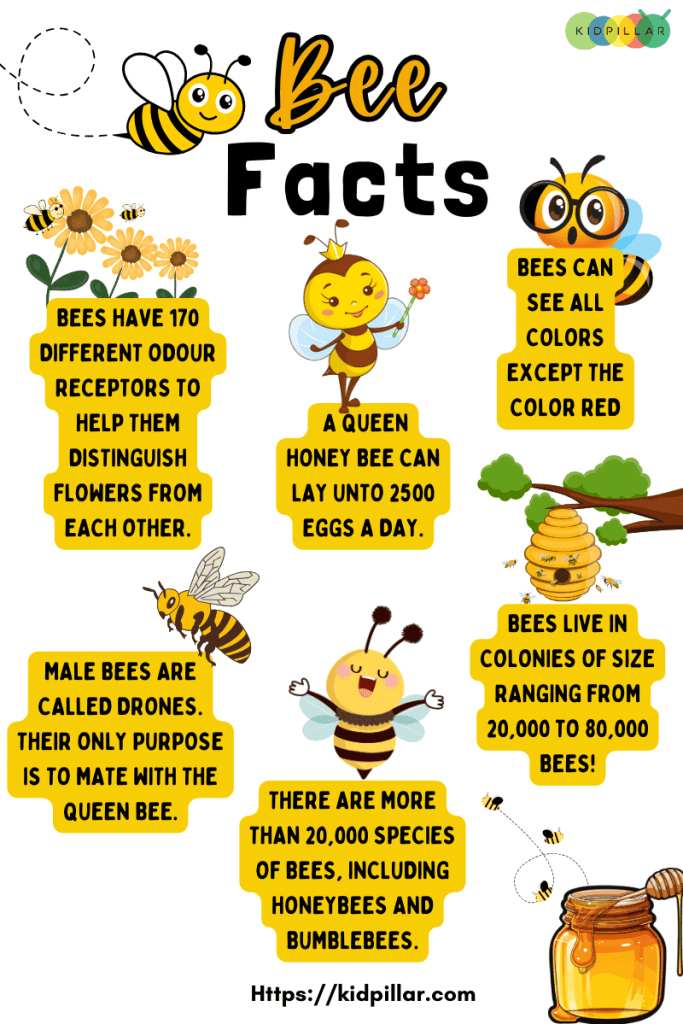
5. Bees have 170 different smell receptors that help them distinguish flowers from each other.
6. The bee family consists of three different members:
- Queen bee: she is responsible for laying eggs. She manages the hive and is supported by worker bees.
- Worker bees: As the name suggests, these are workers who collect nectar, build and clean the hive. The bees you see in your garden are most likely worker bees.
- Drone: male bees are called drones. Their sole purpose is to mate with the queen bee.
7. A queen bee can lay up to 2,500 eggs per day. Crazy, but true!
8. Some bees, such as the carpenter bee, leafcutter bee, mason bee, digger bee, and digger bee, are solitary. That is, they live alone and build their only nest.
9. A queen bee lives approximately 2-5 years, a worker bee lives up to 5-6 weeks, and a drone lives up to 6-7 weeks.
10. Honey bees flap their wings up to 230 times per second.
11. There are more than 20,000 species of bees!
12. Bees live in colonies ranging in size from 20,000 to 80,000 bees!
13. Bees see all colors except “red”.
14. Honey bees fly at speeds of 12-20 miles per hour!
15. The scientific study of bees is called melittology. It comes from the Greek word Melitta – bee!
16. Wallace’s giant bee, also called Megachile pluto, is the largest bee in the world with a wingspan of 2.5 inches. That’s almost the size of a human thumb, which is almost four times the size of an average honey bee!
If you love fun facts for kids, check out 254 Weird But True Fun Facts for Kids.
How do bees make honey?
Honey consists of 80% sugar and 20% water. Bees make this golden, sweet liquid from the nectar they collect from flowers. Honey is the only food of animal origin, made by insects, that is consumed by humans. That really makes it special.
The average honey bee produces only 1/12 teaspoon of honey in its lifetime. So for every teaspoon you have to thank as many as 12 bees.
Making honey is a serious task, and it is what bees do for a living during the cold winter months. But luckily they make way more than they need, so we can have some too!
We have honey bees to thank for honey. To make honey, they visit many flowers to collect their sweet nectar.
Now honey bees have two stomachs. One stomach is for storing honey and the other for food. So, the honey bee collects nectar until its honey stomach is full of nectar and can’t hold any more.
She then flies back to her hive, where she gives the nectar to other worker bees, who then chew on the nectar for about 30 minutes.
After 30 minutes of chewing the nectar, the honey is almost ready. It is then stored in the bee’s own jar, which is the hexagonal cells of the hive.
Finally, other worker bees fan the honey with their wings to make it stickier and less watery. That’s a lot of work!
We should be really grateful to our honey bees for this sweet food of theirs and use it carefully. You can contribute to the welfare of honey bees, to the honey they provide, by planting flowers full of nectar.
Honeycombs: a mathematical miracle
Honey bees are great builders. If you have ever looked at honeycombs, you will realize that they are hexagonal in shape. Isn’t that amazing?
These combs are a mathematical miracle. Practically all honeycomb cells are the same in size and shape. This is not an easy task!
Honeycombs are made from wax produced by bees. Young worker bees are tasked with producing wax.
When a worker bee is almost 10 days old, four pairs of wax-producing glands are activated. These glands produce and secrete wax, which then settles on the sides of the bee’s abdomen.
During contact with air, the wax hardens and settles on the bodies of bees in the form of thin wax scales. After the wax has hardened, the bee scrapes it off its abdomen with its legs.
She then chews the wax to make it soft and pliable to form the hexagonal shape, resulting in honeycombs. A healthy bee can produce eight wax scales in 12 hours. One gram of beeswax requires approximately 1,000 scales. Quite a lot of work!
Honeycombs are a great example of mosaics that occur in nature. Bees use this mosaic structure to maximize storage space while using a minimum of wax to make them. Simply amazing!
Beeswax, like honey, is valuable for humans. It is used in lip balms, body lotions, candles, and as a coating and varnish.
Activities with bees for children
These simple bee activities for toddlers, preschoolers, and kindergarteners are the perfect way to teach them about these wonderful creatures.
1. Drink like a bee
This is a fun bee activity for preschoolers that will help them understand how bees drink nectar. Bees have a long hairy tongue that resembles a mop.
It is covered with tiny hairs that rise when the honey bee dips its tongue into the nectar. This allows more nectar to stick to the hairs, so the honey bee can suck up more nectar with each sip.
To understand how it works, try this simple action.
- Brush for old mascara/small bottle
- Straw
- A cup/bowl
- Paper craft
- Scissors
- Tape
- Honey
- Thick paper towels
Step 1: Take a cup and fill it halfway with honey. Put it aside.
Step 2: Draw a flower on craft paper and cut it out with scissors.
Step 3: Cut a small hole in the center of the flower.
Step 4: Glue the flower to the honey bowl to seal it with tape.
Step 5: Ask the child to hold the straw in his/her hand. mouth and dip it into the flower to recreate a honey bee drinking nectar.
Step 6: Repeat step 5 with the mascara/bottle brush.
Step 7: Using a paper towel, wipe the straw and the brush to see which tongue picked up more honey.
This super easy activity will help your child understand why a honey bee’s tongue has hairs on it and how they help it drink nectar.
For our activity, we even made a headband to get the feel of a real bee and add even more fun.
2. Learn about bees
This bee day, make sure you learn all about bees in the most fun and engaging way possible with these bee worksheets. Easy to understand and engaging, these worksheets help children not only learn about the parts of a bee, the life cycle of a bee, but also to think and match them with the clues and think about their meaning.
3. Activity of bees in pollination of flowers
This is one of the best and easiest bee activities for kids that will help your kids learn about pollination in a hands-on way.
Understanding pollination and how bees and birds help in pollination is a bit difficult for children to grasp. This simple STEM activity makes it easy for kids.
All you need is a bag of cheesy nachos or salty cheesy popcorn and a bowl. Other flavors work too, but this one works the best!
Step 1. Pour nachos into a bowl.
Step 2. Ask your little ones to feel with a few hands. It is forbidden to lick your fingers!
Step 3: After they have taken a few bites, ask them to touch the tissue paper.
What do you see? Is there magic pollen on the cigarette paper too? Just as some condiments stick to your hands when you eat with your fingers, pollen sticks to the bodies of bees and birds.
And when they fly to other flowers, this pollen falls and is transferred to other flowers and plants. Simple pollination!
Bees are great pollinators and we need them to maintain our ecological balance! They are our natural pollinators and we cannot do without them.
Related: Also check out Plant Activities for Kids That Make Learning Fun.
4. Build Bee’s Eyes STEM Challenge
Ask your child to swat a bee or a fly? When they think they have caught them, it flies away. This is because of his incredible vision, which can detect movement far better than the human eye.
Bees and flies have compound eyes. This enables them to see over a much wider range and gives them an unrivaled ability to detect movement in their field of vision.
This easy and simple bee-themed activity for kids will help them understand the anatomy of complex eyes.
Bee activity free printable
Print this free Bee Eyes printable and use common materials from your pantry to build a compound for the Bee. eyes
5. Create honeycombs
This is one of the bee activities for kids with a strong focus on math. Invite your child to create perfect honeycombs.
- Old newspapers/brown craft paper
- Scissors
- Pencil and scales
Step 1: Take newspaper/craft paper and draw a hexagon with a pencil and scale.
Step 2: Cut out the hexagon. You will need at least 20 of these.
Step 3: Place the hexagons next to each other to create the perfect beehive.
It’s relatively easy to do, but just imagine the hard work the bees put into creating their home.
Similar to: Gamify math with Math Games for Kindergarten!
6. Buzzing Bee Noise Maker
Imitate the sound of a bee buzzing with this cool STEM Bee activity for kindergarteners and older kids. Your kids will love it.
- A large popsicle stick
- Double-sided tape/foam tape
- Yarn
- Big eraser
- Paper for needlework
- Office tape/glue
- Scissors
Step 1: Take your craft paper and cut it into a rectangle with the long side 2 inches shorter than the length of the popsicle stick.
Step 2. Trim the two corners of the long side of the rectangle.
Step 3: Adhere the craft paper to the popsicle stick, leaving an inch on each side and covering half its width.
Step 4. Tie a thread on one side of the popsicle. Leave the other end of the string loose and long enough to twist the popsicle stick.
Step 5: Attach the double sided tape to both sides of the double sided tape.
Step 6: Thread the elastic over the double-sided tape along the popsicle stick.
Twist your buzzing insect toy to hear the buzzing of insect wings.
Ознайомтеся зі звуковими заняттями для дітей, щоб познайомити дітей із наукою про звуки!
Work towards UN SDG 15 by planting your own bee-attracting flower garden by following these guidelines:
- Plant flowers that attract bees, such as dandelions, clover, mint, pansies, snowdrops, marigolds, peonies, nasturtiums, sweet peas, etc.
- Plant different flowering plants according to the season to maintain a blooming garden throughout the year
- Do not use hybrid flowers and plants as they are much less beneficial to bees than their natural counterparts.
- Say No to pesticides and fertilizers because they contain chemicals that harm our natural pollinators
These beautiful, educational bee activities are sure to get your child thinking about our beneficial natural pollinators and encourage them to do their part to save bees from extinction.
Related: Get kids interested in gardening with this easy gardening guide for kids.
9. A paper bee
This cute paper bee is easy to make and perfect for getting kids interested in bees.
This would make a great decoration for World Bee Day!
10. Read books about bees.
Choose books about bees in May. These wonderful books will draw your children’s attention to these insects to save the bees.